

Infrastructure owners invest millions to produce the documentation that underpins the construction and maintenance of their assets. However, the sheer volume of data makes it nearly impossible to locate critical details on demand, even with robust information management systems in place.
AtkinsRéalis encountered this exact challenge whilst implementing a cutting-edge predictive maintenance approach for the road network at a UK international airport. Their model required pavement construction details, installation dates, and traffic flow data to be extracted from a sprawling mix of as-built records, site logs, and design files.
The problem was threefold:
- Knowing where to look. Although documents followed the client's naming convention, this only enabled the team to identify groups of relevant documents, which then needed to be opened and interrogated manually.
- Missing context. When documents were migrated from the client's repository, the metadata used to filter and navigate them efficiently was stripped - a common problem when moving information between Common Data Environments.
- Overwhelming scale. With thousands of documents covering hundreds of roads, manual review would be prohibitively slow and costly.
Our approach
Hoppa's approach is Human + AI, not AI instead of human: a hybrid, human-in-the-loop model designed for large, governance-critical infrastructure environments where general purpose AI tools fall short. Hoppa focuses on surfacing verifiable facts from vast and diverse datasets, with built-in safeguards against AI hallucinations so only genuinely relevant documents are flagged and engineers can validate outputs with confidence.
Even with enterprise access to Microsoft Copilot and other AI platforms, Hoppa stood out as the right solution for AtkinsRéalis in this scenario, thanks to its ability to handle domain-specific datasets in a way that engineers can easily verify and assure.
From isolated archives to model-ready data
- Problem-led configuration: Hoppa was configured to search for targeted terms (e.g., "Pavement Construction", "Material Test Results").
- Structured interrogation at scale: Hoppa was configured to ask key details of all documents across multiple query parameters, returning answers only where relevant.
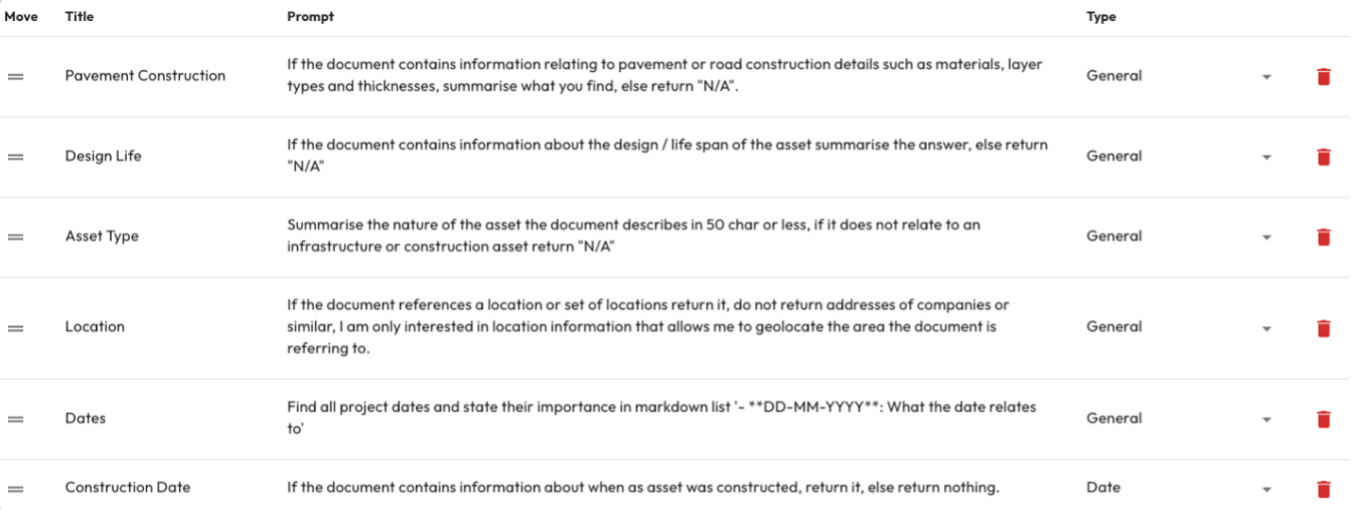 Hoppa was configured to ask key details of all documents, returning answers only where relevant
- Automated extraction and summarisation: When relevant information was found, Hoppa automatically extracted and summarised it - across diverse sources including scanned handwritten site logs and technical drawings.
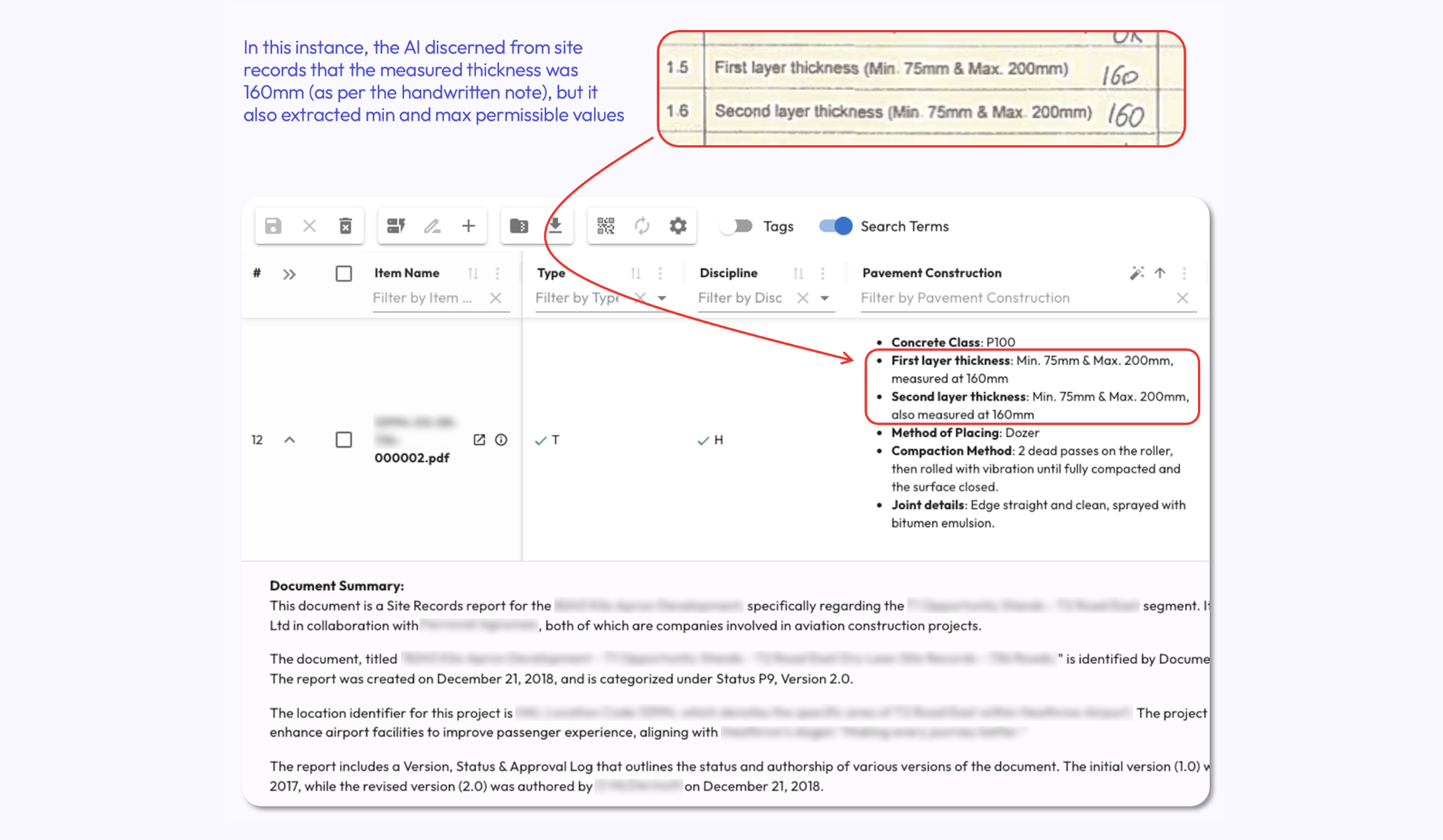 Hoppa identified and extracted facts from drawings, handwritten notes, engineering reports and more
-
Focusing effort where it was needed: Follow-on functions performed Red-Amber-Green assessments to target engineers' attention to documents of interest.
-
Ready-for-use outputs: Raw extracted data was transformed and cleansed into formats ready for direct input into the insights engine, replacing manual clean-up workflows.
Hoppa by numbers
Prior to scaling across the entire roads network, AtkinsRéalis commissioned a controlled study over a single 800-document roads package. They quantified the potential upside by running the work in parallel - manual human review versus Hoppa-assisted analysis.
59 hours → 7 minutes. Time to completion reduced from 59 hours (human-only) to 7 minutes (Hoppa-assisted, validation included) - a 500× improvement.
97% correlation to human findings. Hoppa identified 75 relevant documents whilst the human team found 73, demonstrating close alignment with manual review and validating accuracy at scale.
Major infrastructure scale. Following proof of value, AtkinsRéalis deployed Hoppa across the entire airport road network, processing thousands of additional documents with the same dramatic efficiency gains.
Following this benchmarking exercise, the method was scaled and the entire road network was processed within extremely ambitious client timeframes.
From reactive to predictive
Hoppa's hybrid workflow paired automated discovery and extraction with human validation, enabling AtkinsRéalis to identify relevant documents across multiple query parameters and transform decades of fragmented records into structured, model-ready data for their predictive maintenance model.
Airport asset management shifted from reactive to proactive, demonstrating that in infrastructure information management, the future is AI and human working together, not AI versus human.

“While engineering judgment remains essential for interpretation, Hoppa transforms desktop workflows, optimises resource utilisation, and reduces potential unnecessary intrusive site investigations. It is strongly recommended that Hoppa be adopted as a core component of desktop analysis to maximise efficiency, lower costs, and enable data-driven decision-making across the network.”
Looking ahead
For large asset owners, decades of design and construction history represent both a challenge and an untapped advantage. By making legacy data instantly accessible and actionable, Hoppa can turn static archives into a live knowledge base to power proactive asset management and smarter, data-driven decisions.
Feeling inspired?
See Hoppa in action and learn how it can make the difference to your workflows.